
IHI outlines strategy to convert global expansion into shareholder returns
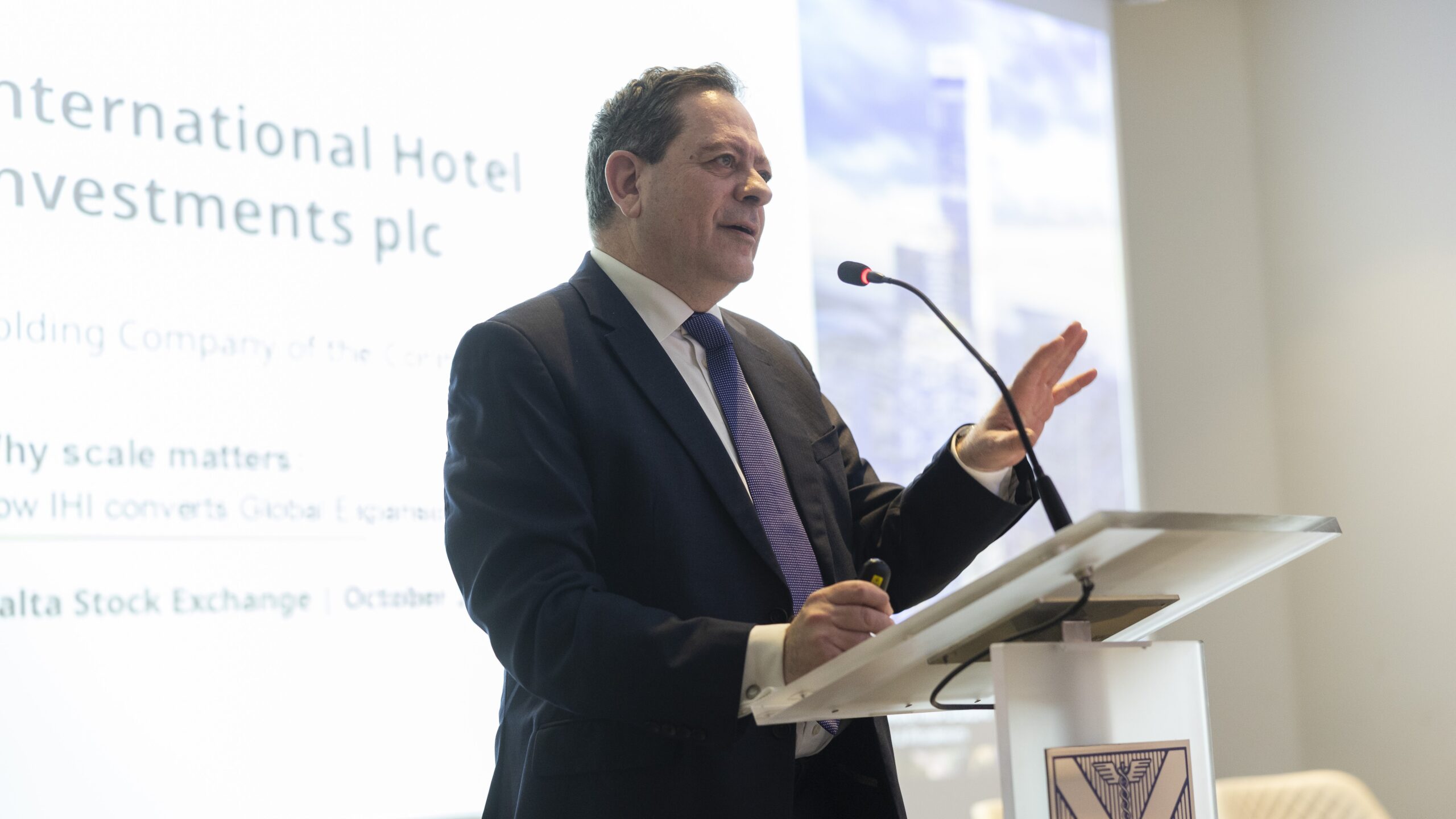
The Malta Stock Exchange hosted its first Investor Day Conference on 29 October 2026. As part of our ongoing coverage, we are delving deeply into each of the major speeches and presentations throughout the day.
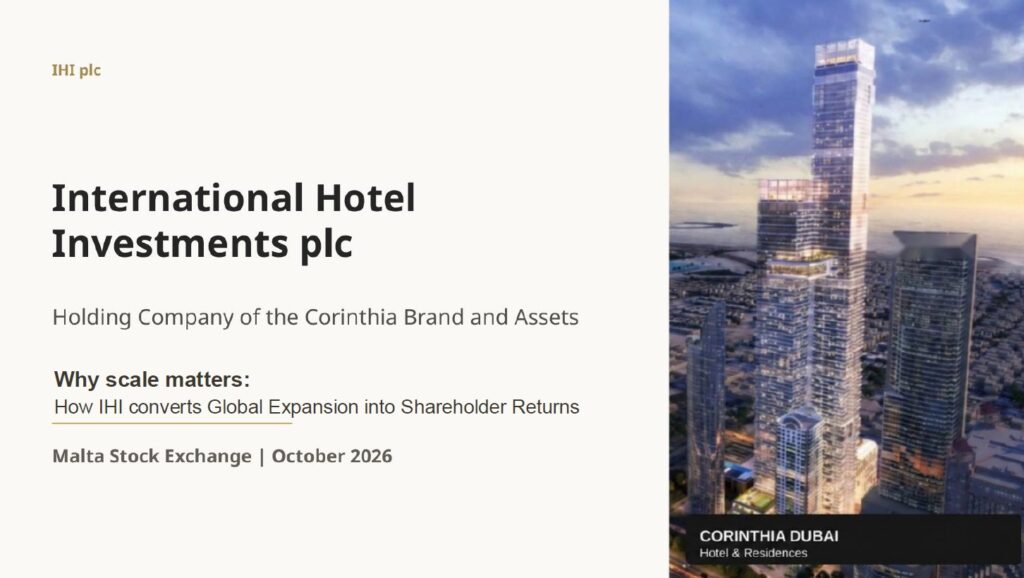
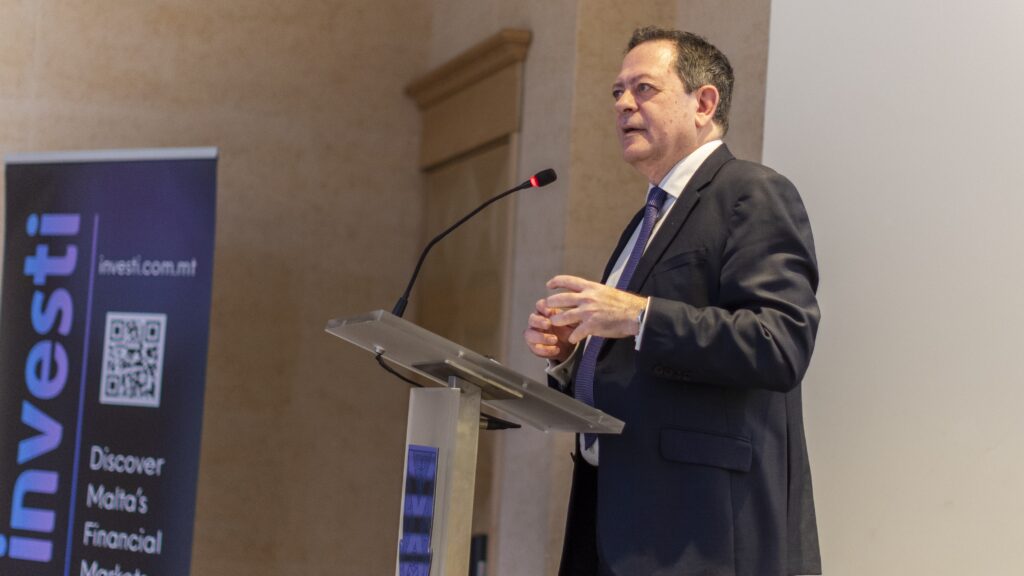
Simon Naudi, Chief Executive Officer of International Hotel Investments plc (IHI), set out the group’s strategy for turning the international expansion of the Corinthia brand into long-term shareholder value in a presentation titled “Why scale matters: How IHI converts global expansion into shareholder returns”.
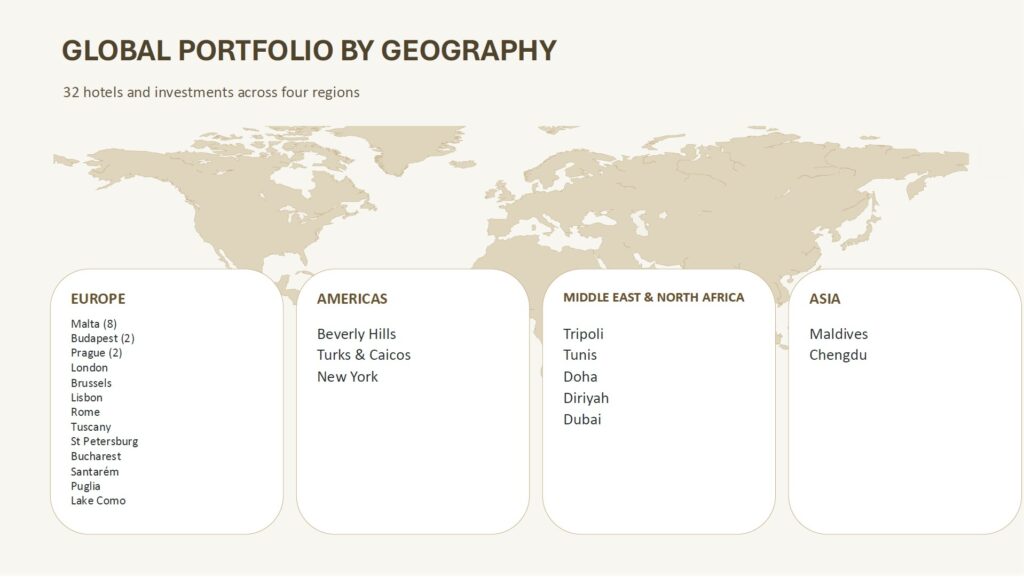
He traced the Corinthia Group’s origins to 1962 – where a restaurant opened by Alfred Pisani and his family in Balzan, Malta, still operates, with Malta accounting for roughly 20% of the business – to a holding company overseeing the Corinthia brand and a portfolio spanning 32 hotels and investments across Europe, the Americas, the Middle East and North Africa, and Asia.
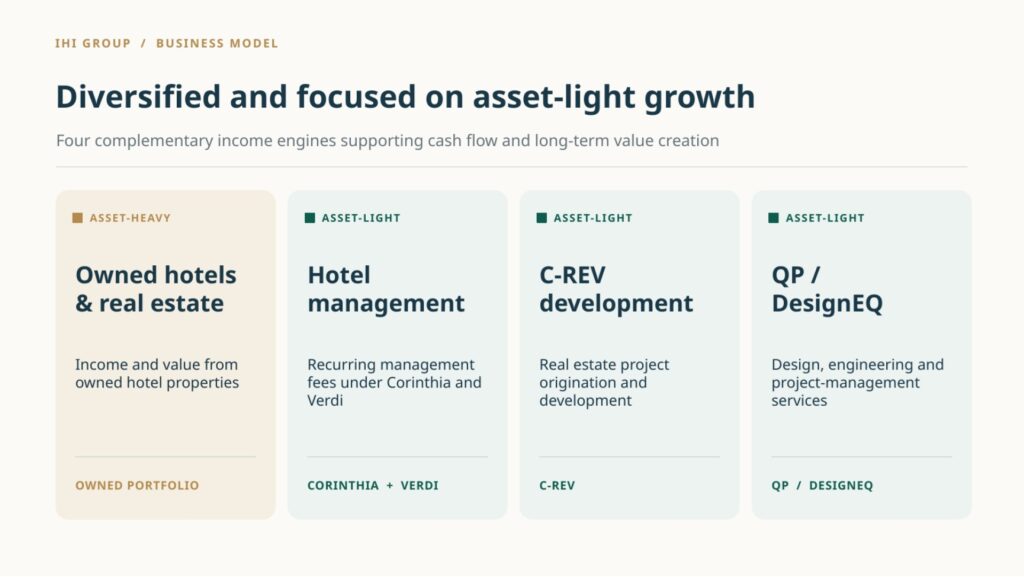
IHI, established in 2000 and listing on the Malta Stock Exchange in April that year, as a spin-off from the founding Corinthia group, reported gross assets of approximately €2 billion and a net asset value of around €900 million. Mr Naudi said it has received €650 million in shareholder capital and operates through a combination of asset-heavy and asset-light businesses.
Alongside hotel and real estate ownership, it is increasingly focused on hotel management, development activities through its C-REV platform, and design and project management services through QP/DesignEQ. These businesses are intended to create multiple sources of income and support long-term growth.
Internationalisation
A central theme of the presentation was the internationalisation of the Corinthia brand. Mr Naudi highlighted a series of recent high-profile hotel openings in Brussels, New York, Bucharest and Rome, describing them as flagship properties that have enhanced the group’s international profile.
Alongside expansion, IHI continues to invest in its existing assets through refurbishment programmes in Malta, Budapest and London in an effort to improve competitiveness and increase room rates. Mr Naudi also outlined plans to reposition certain assets, including developments at Golden Sands and Hal Ferh in Malta, while reassessing opportunities to maximise value from existing properties.
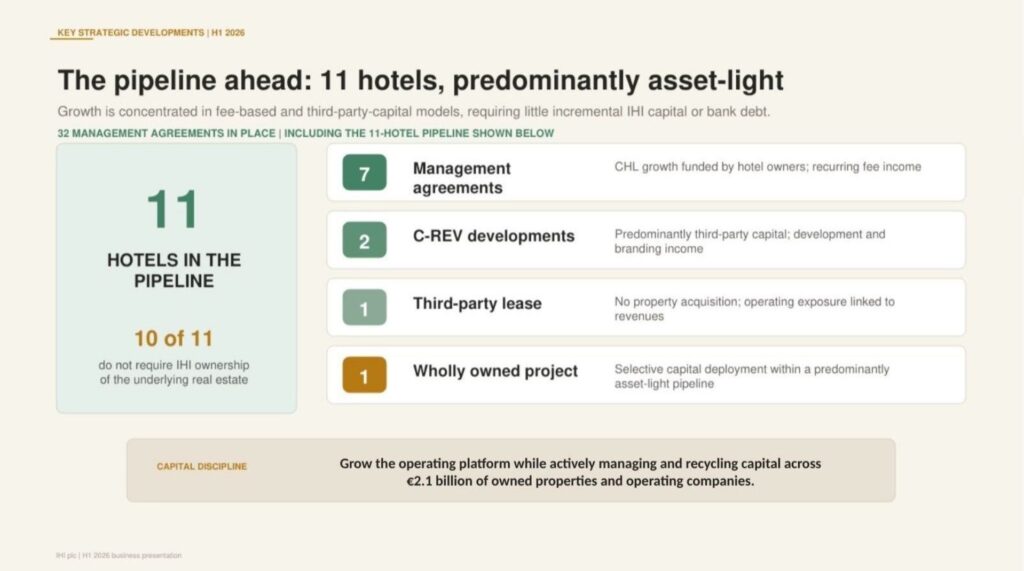
He devoted considerable attention to the group’s shift towards asset-light growth. Rather than relying solely on owning hotels, IHI increasingly seeks to earn management fees, branding fees and development returns from hotels financed by third parties. The company said seven of the 11 hotels currently in its development pipeline are management agreements; only one project is wholly owned by IHI.
Examples cited included long-term management agreements in New York and Puglia, and a 40-year lease arrangement in Rome. These arrangements can generate recurring income streams with relatively limited capital investment.
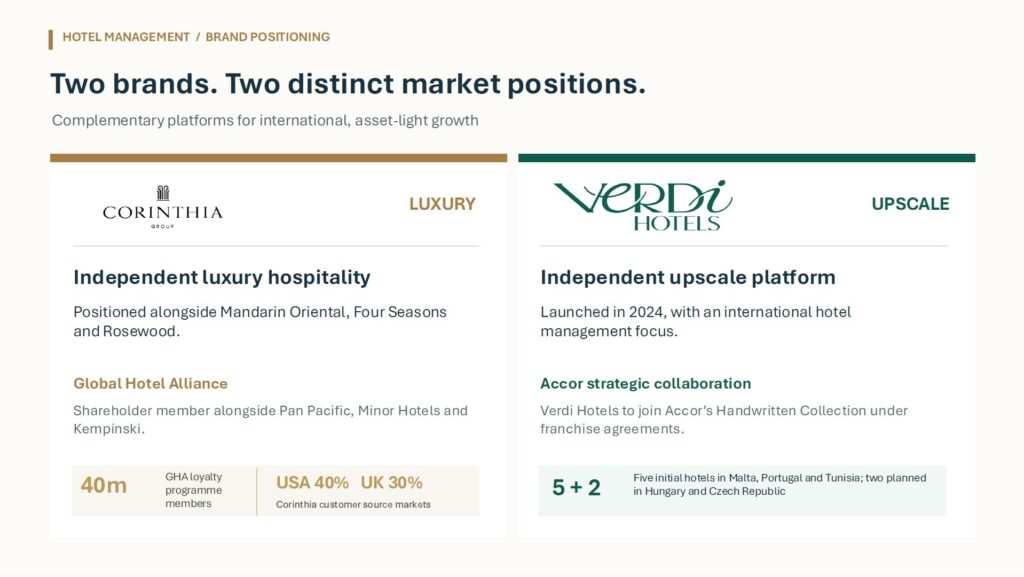
Recurring management fees will be received under both the Corinthia and Verdi brands. Corinthia is positioned in independent luxury alongside Mandarin Oriental, Four Seasons and Rosewood, and is a shareholder in the Global Hotel Alliance alongside Pan Pacific, Minor Hotels and Kempinski (a loyalty programme with around 40 million members). Verdi Hotels, launched in 2024 as an independent upscale platform, is to join Accor’s Handwritten Collection under franchise agreements, with five initial hotels in Malta, Portugal and Tunisia and two planned in Hungary and the Czech Republic.
A further growth avenue is C-REV, the group’s real estate development platform. Mr Naudi highlighted projects in Beverly Hills and Turks & Caicos, where IHI contributes expertise, branding and project development capabilities while raising much of the required capital from external investors and lenders. He said this model allows it to participate in potentially significant value creation while committing comparatively modest amounts of its own capital.
Active management of owned assets
IHI is refurbishing owned properties to lift room rates and competitiveness – including the Corinthia Palace (€7.5m, 71 bedrooms completed over 18 months) and Corinthia St George’s Bay (€5m, lobby and bedrooms with 52 rooms completed) in Malta, Corinthia Budapest (€20m financed by Erste Bank across 384 of 414 bedrooms and selected public areas), Corinthia London (€15m across lobby lounge, specialty restaurants, meeting areas and 229 of 279 bedrooms) and Corinthia St Petersburg (€5m across a restaurant and 52 of 380 bedrooms).
It is also re-evaluating assets – such as branding and timeshare resolution at Golden Sands, portfolio configuration at St George’s Bay, permitted hotel and serviced-villa development at Oasis (Hal Ferh), and pausing a sale of Grand Hotel Prague following masterplan rezoning that permits residential use and further development on vacant land.
AI in hospitality
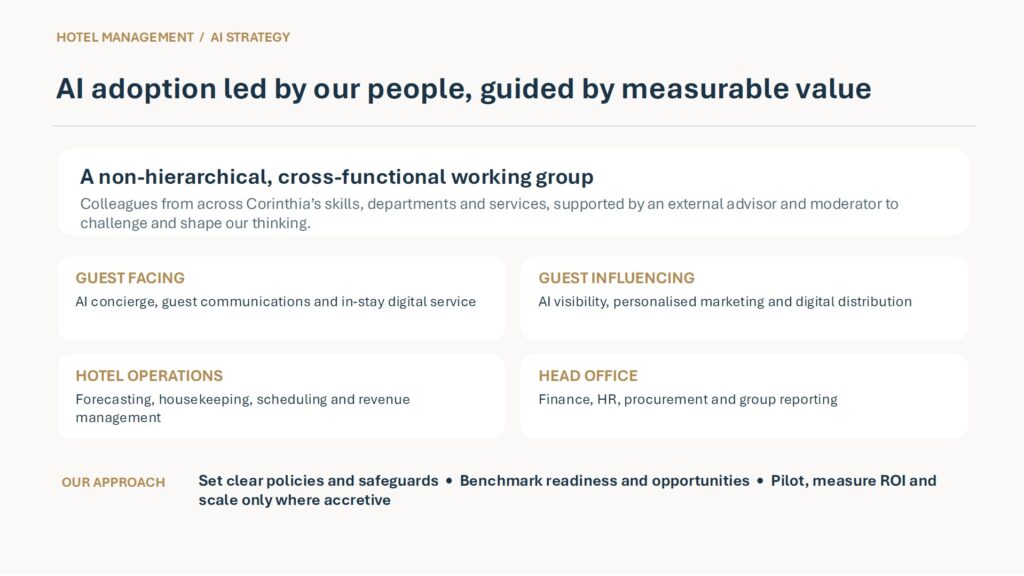
Mr Naudi discussed the role of artificial intelligence in hospitality. IHI has established a cross-functional AI working group and identified opportunities in guest services, hotel operations, marketing, revenue management, finance, human resources and procurement. One example he cited was the use of AI in food waste monitoring, which the company said had already generated cost savings in a hotel kitchen operation.
Looking ahead, Mr Naudi outlined a four-year business plan centred on managing and extracting value from existing assets while expanding higher-margin operating activities. The company said it aims to increase group EBITDA from approximately €62 million to €95 million and reduce debt from about €670 million to €570 million. It also intends to grow its hotel portfolio from around 30 to 50 hotels and increase earnings from hotel management activities.
Questions from investors focused heavily on the gap between the company’s operational progress and its share-price performance. Responding, Mr Naudi argued that the market does not fully reflect the value of the group’s asset base and growth prospects. He pointed to recent asset sales, including the disposal of a majority stake in the Lisbon hotel while retaining a management contract, as examples of how the company intends to demonstrate and unlock underlying value.
He also stressed that future growth would increasingly come from management contracts and other fee-generating activities rather than capital-intensive ownership, allowing the business to scale internationally with lower incremental capital requirements.
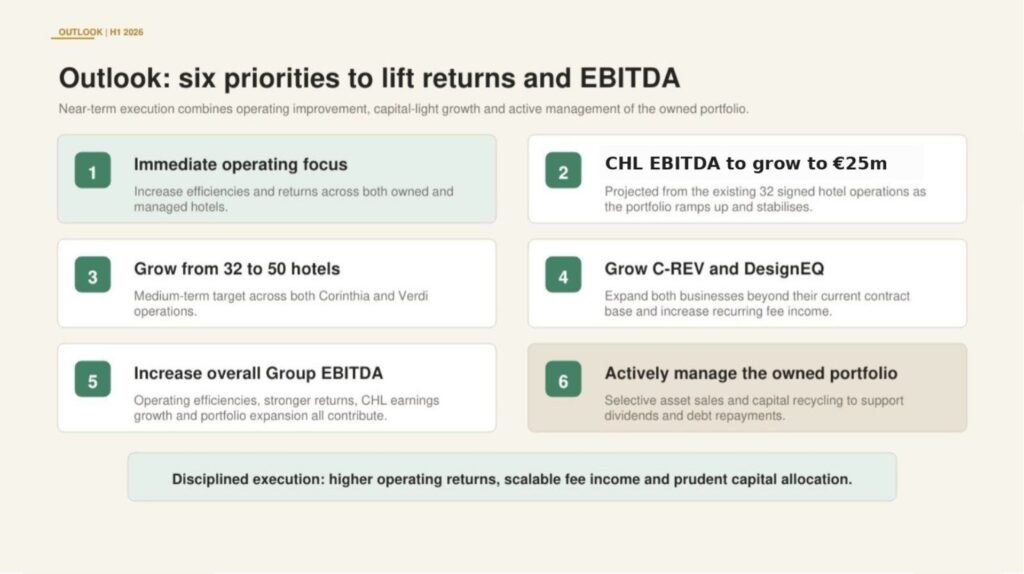
Top three takeaways for investors
1. IHI is shifting towards an asset-light growth model
A key message was that future expansion will increasingly be driven by hotel management agreements, branding income and development activities rather than ownership of hotels. Mr Naudi argued that this model offers recurring fee income, lower capital requirements and greater scalability.
2. Unrealised value within the asset portfolio
Mr Naudi highlighted the difference between the valuation of its assets and the market value implied by its share price. Asset sales, redevelopment opportunities and portfolio repositioning were presented as mechanisms for unlocking value and strengthening the balance sheet. Investors are presented with a strategy of funding capex, debt reduction, strategic investments and distributions through selective asset sales (such as Lisbon) and value re-evaluations (such as Prague), while the Group addresses long-standing questions over how market trading reflects underlying property and operating value.
3. Financial targets centred on earnings growth and debt reduction
The group’s four-year plan targets raising Group EBITDA by roughly €33m (from €62m to €95m) and cutting bank and bond debt by around €100m (from c. €670m to c. €570m) against gross assets of c. €2bn and net asset value of €0.9bn (with share capital of €615m and shareholding split 58% CPHCL, 22% Investment Corporation of Dubai, 11% LAFICO and 8% Maltese general public). Mr Naudi presented these objectives as evidence that expansion, asset management and operating growth are intended to translate into improved financial returns over time.