
Growth through stability: banking, shareholder value and customer trust in an uncertain world
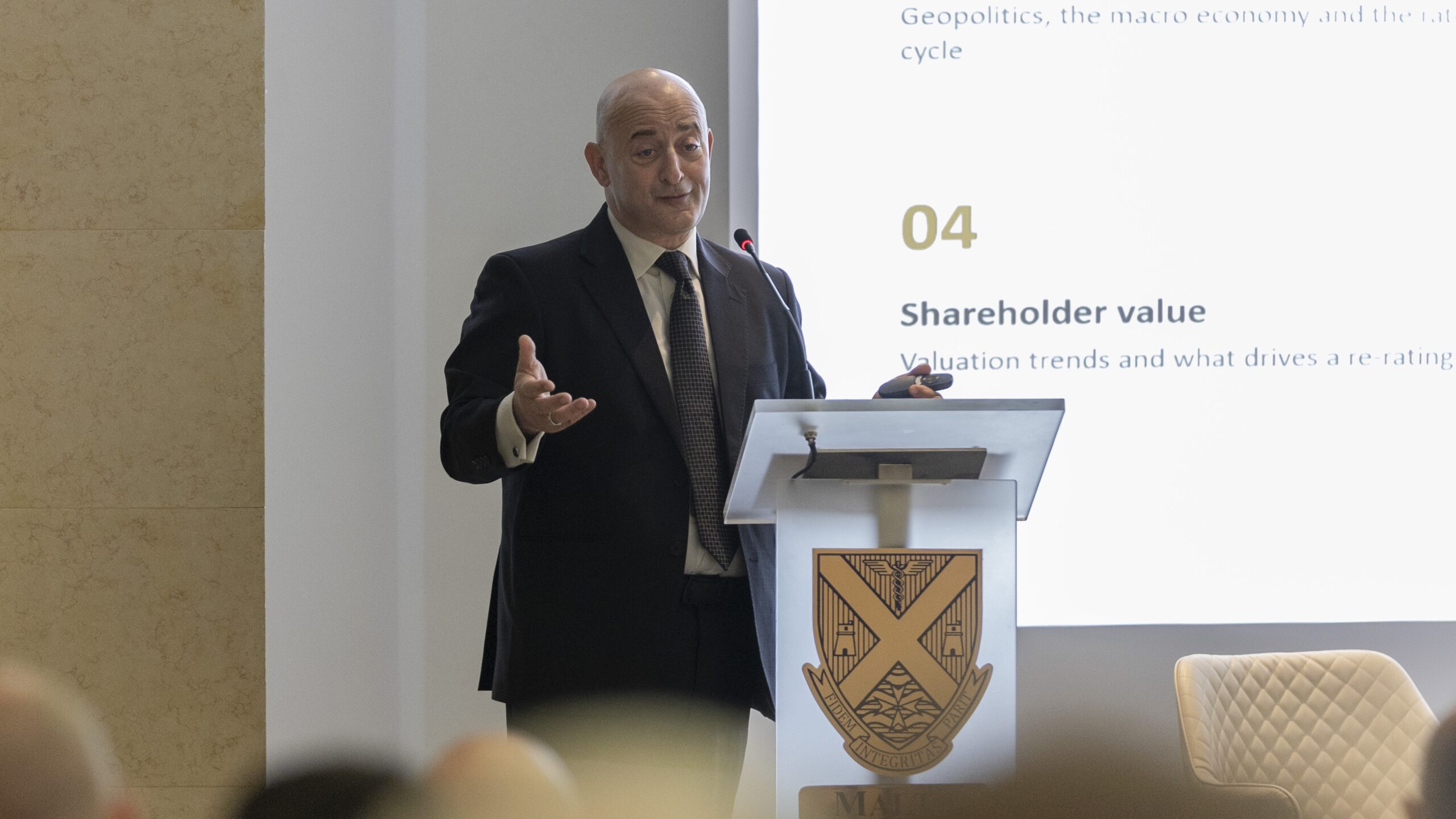
The Malta Stock Exchange hosted its first Investor Day Conference on 29 October 2026. As part of our ongoing coverage, we are delving deeply into each of the major speeches and presentations throughout the day.

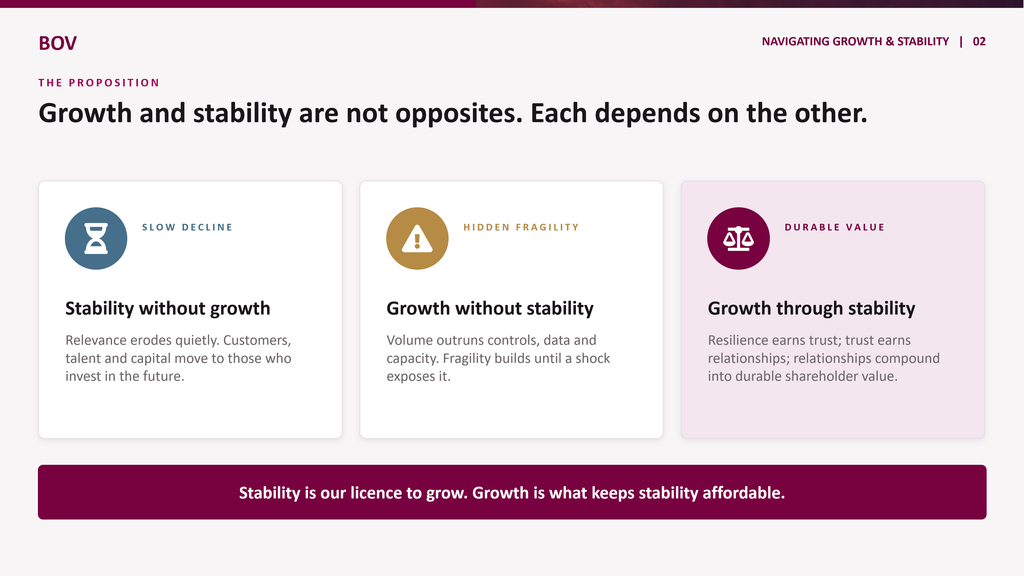
Kenneth Farrugia, Chief Executive Officer of Bank of Valletta plc, argued that growth and stability should not be viewed as competing objectives. Instead, he presented them as mutually reinforcing, contending that resilience creates trust, trust supports growth and sustainable growth ultimately drives shareholder value.
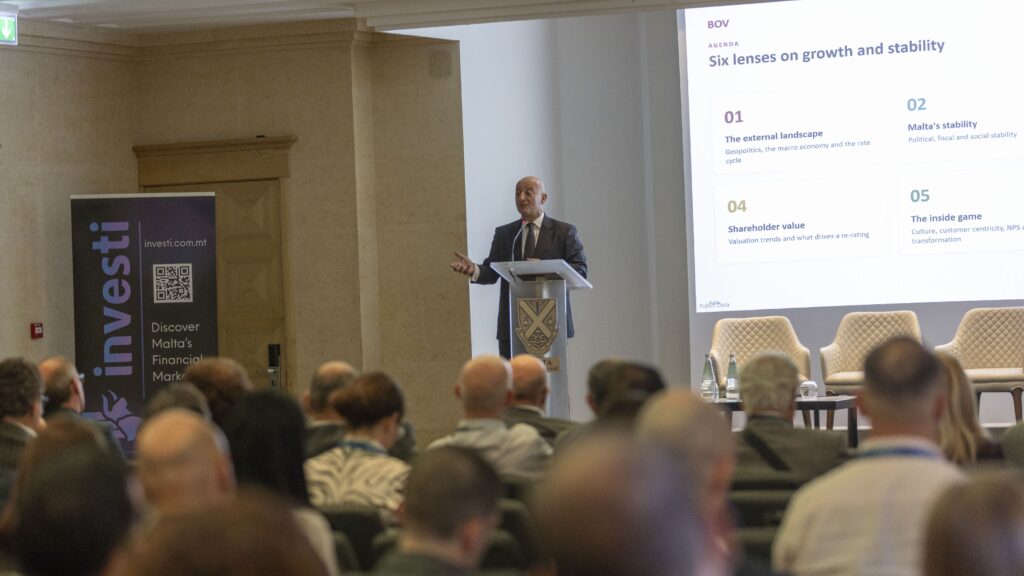
The presentation, titled Navigating Growth and Stability, was built around six themes: the external environment, Malta’s stability, competition and regulation, shareholder value, organisational culture and customer focus, and the balance between growth and risk management.
Growth and stability are interdependent
A central theme of the presentation was that businesses cannot pursue growth at the expense of resilience, nor remain focused solely on stability without continuing to evolve. Mr Farrugia described resilience as the foundation of trust, and trust as the basis for long-term growth and value creation.
He argued that organisations must manage both dimensions simultaneously, rather than treating them as separate strategic priorities. According to his framework, growth without adequate controls creates fragility, while stability without growth leads to declining relevance.
A more uncertain operating environment
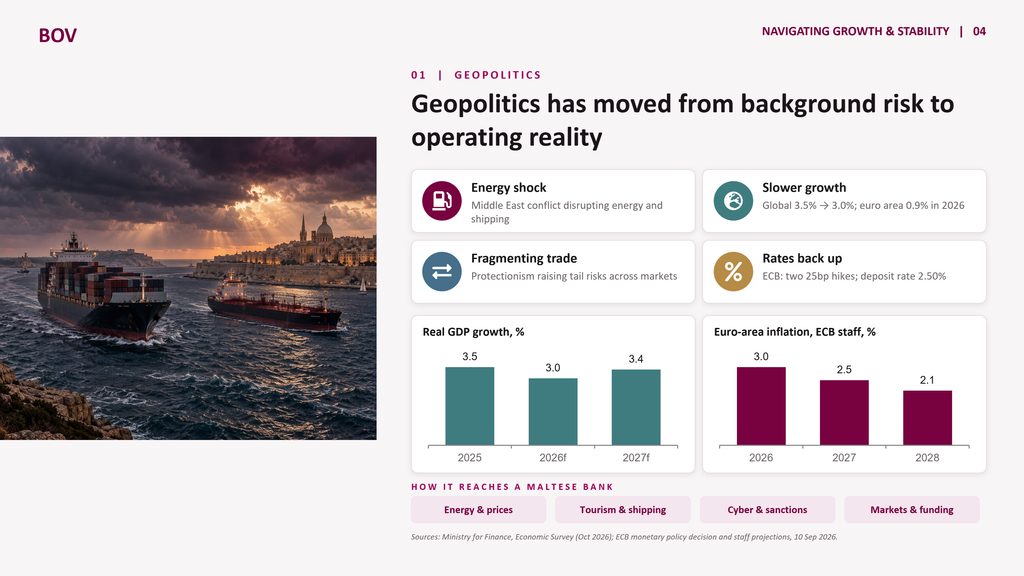
Mr Farrugia highlighted a range of external factors influencing both corporate performance and investor confidence. These included geopolitical tensions, inflation, supply-chain disruption, tariffs, changing interest-rate conditions and increasing competition. He noted that such developments affect business models, funding costs and economic activity, even when they are largely beyond the control of individual institutions.
Geopolitical risks have moved from being largely theoretical concerns to becoming practical operating realities for businesses and banks, Mr Farrugia emphasised. Organisations therefore need contingency planning, resilience measures and the ability to adapt quickly to changing conditions.
Malta’s economic strengths, but also its challenges
Mr Farrugia presented Malta as relatively well positioned compared with many European economies, citing strong economic growth, economic diversification and favourable macroeconomic fundamentals. He argued that diversification across multiple sectors has helped shield Malta from external shocks and contributed to its resilience.
At the same time, he identified several structural challenges that require attention, including labour shortages, infrastructure pressures, population aging and inflation management. He suggested that greater investment in technology could help reduce excessive dependence on labour and improve productivity across the economy.
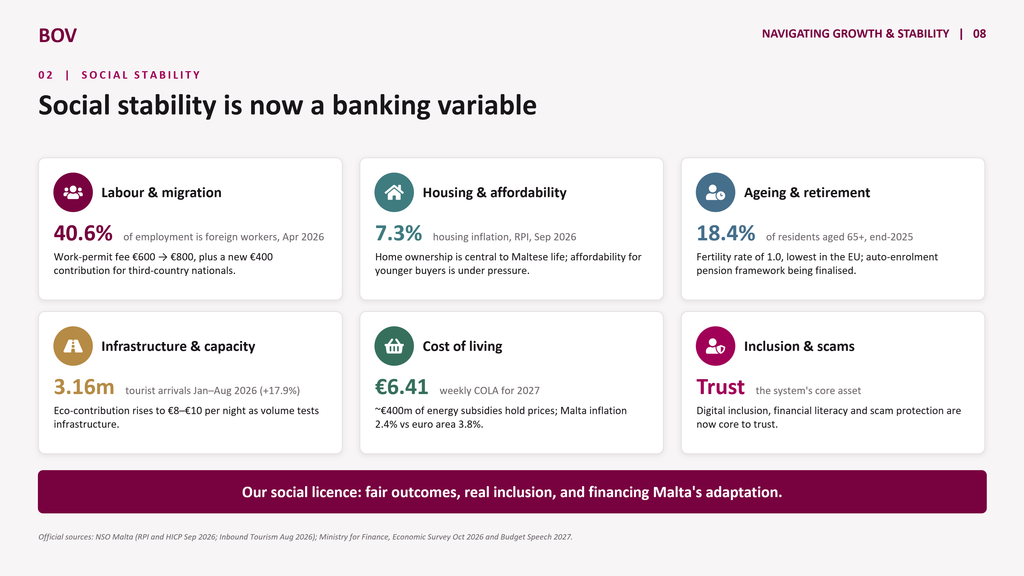
Social stability also featured prominently in his analysis. He argued that factors such as housing affordability, migration, retirement provision and cost-of-living pressures increasingly influence economic performance and, therefore, affect both growth prospects and financial stability.
Competition and regulation are reshaping banking
Mr Farrugia said the competitive landscape will continue to intensify as new entrants, digital challengers and international operators expand their presence in the market. Success, he argued, will depend not only on pricing but also on productivity, service quality, speed of delivery and customer experience.
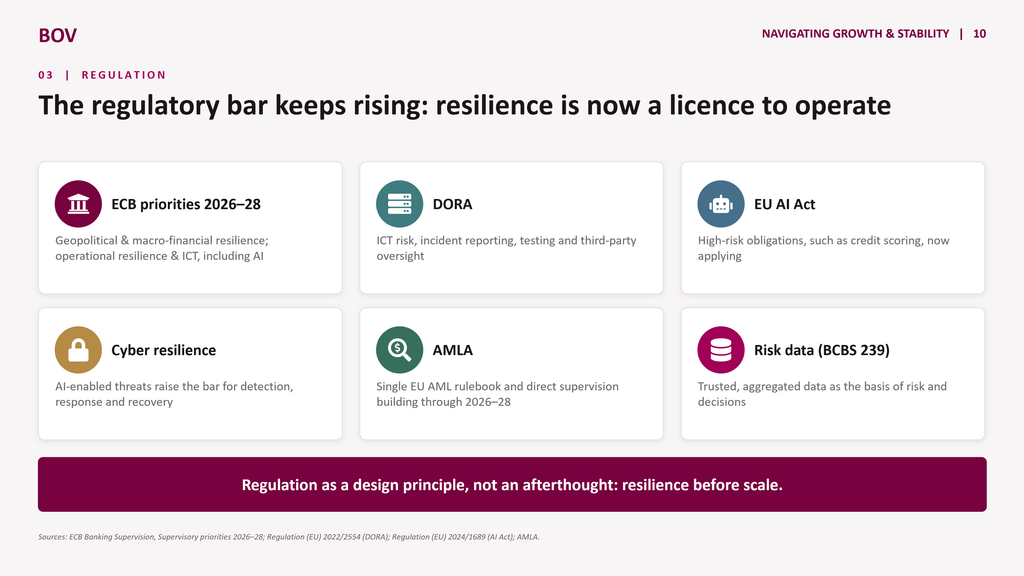
He went on to examine the growing regulatory burden on banks. While he acknowledged that regulation has strengthened resilience and balance sheets, he argued that future regulation should also encourage innovation and economic development rather than focusing exclusively on risk mitigation.
Shareholder value remains a central measure of success
Addressing investors directly, Mr Farrugia identified dividends, return on equity and share-price performance as key measures through which shareholders assess value. He said these metrics remain central to boardroom decision-making.
He referred to initiatives, such as share buy-backs and capital-market activity, as measures that can support investor confidence. Mr Farrugia also highlighted the importance of developing stronger pension participation and broader investment activity in Malta, arguing that deeper capital markets would help channel savings more productively into the economy.
The importance of maintaining sustainable returns through a combination of stable earnings, disciplined capital allocation, diversified sources of revenue and prudent risk management was stressed.
Customer focus, culture and transformation
Internally, Mr Farrugia argued that organisational culture is one of the most important factors influencing both growth and stability. He linked strong cultures to effective risk management, customer-centric decision-making and long-term performance.
Customer relationships were presented as a key differentiator in an increasingly competitive market. He stressed the importance of combining physical, digital and advisory channels while using data analytics to better understand customer needs and improve service delivery.
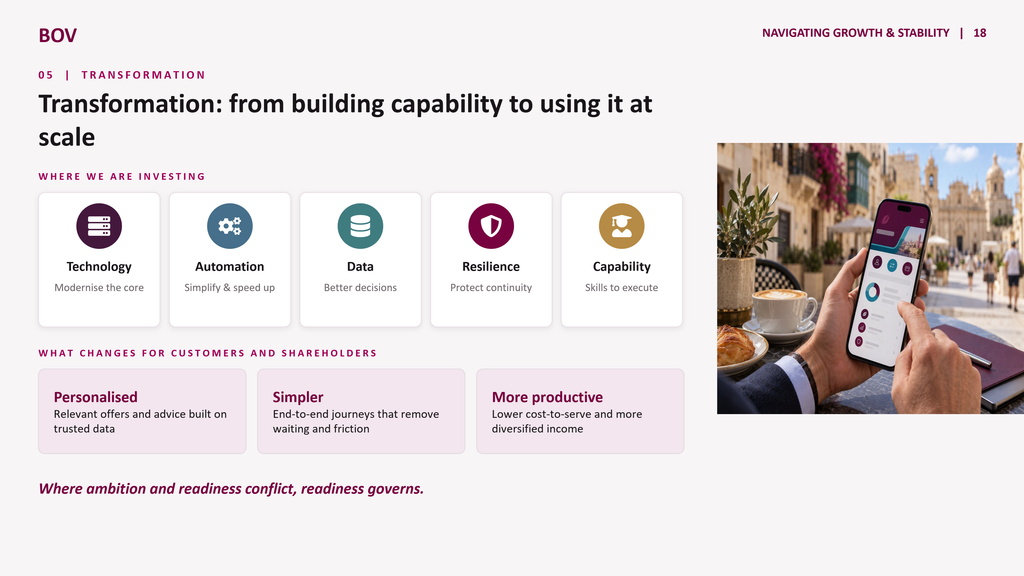
Transformation initiatives, meanwhile, were described as focused on technology, automation, data, resilience and employee capability, with the objective of improving productivity, simplifying customer journeys and supporting future growth.
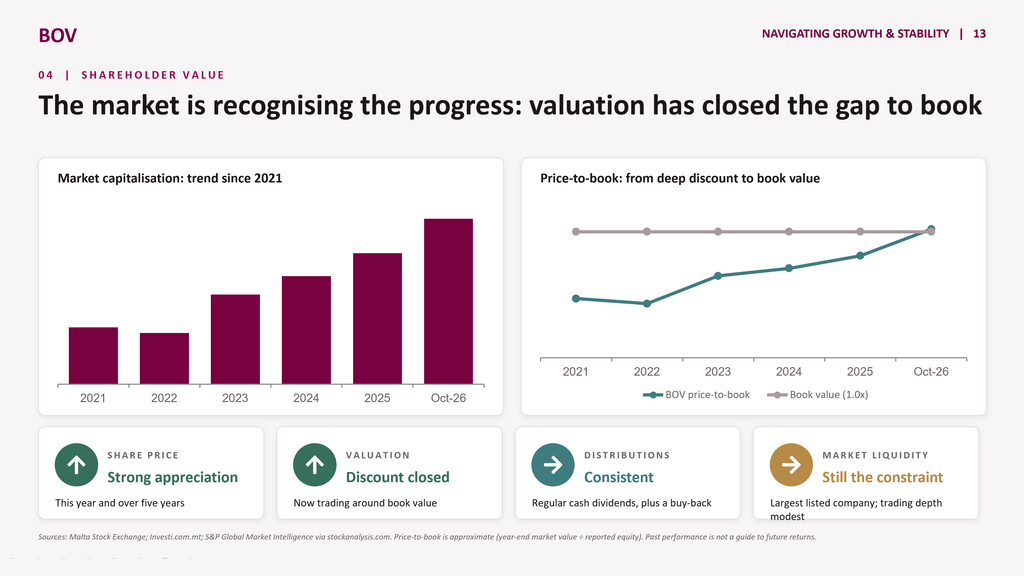
Malta Stock Exchange Executive Chairman Joseph Portelli was the first to comment. He pointed out that BoV is too modest, with shares up 280% in the past five years when taking into consideration reinvested dividends and a compound annual growth (CAGAR) of 30% (source: www.investi.com.mt).
He went on to point out that there are 10,000 hedge funds in the United States with 35% to 45% of them managing less than $100 million. “There’s no reason why these small hedge funds can’t buy 2% of their assets in stocks listed in the Malta Stock Exchange. Some of our companies would be perfect for hedge funds in the United States,” he said.
There were two other questions on whether the bank has plans to more productively employ its excess cash and on whether it has plans to be more active internationally.
Mr Farrugia said the aim of his presentation was to share the different lenses around the topic of growth and stability. He went on to stress the importance of culture, a programme of initiatives around change management and customer centricity. He said he is a firm believer in metrics, using data analytics to uncover trapped value. The bank employs 2,400 and the challenge is where to shift capacity to ensure execution and deliverability of a significant number of projects, with trust being the anchor.
On the use of excess cash, Mr Farrugia said it was always a balance between the liquidity attracted as an organisation, the extent to which it is deployed in the economy through credit financing solutions and the way it is managed in the markets. BoV has shifted significant liquidity – over €4 billion over these last few years – into Treasury instruments. The bank’s loan to deposit ratio has grown to 60% and it sees significant opportunities in the domestic economy.
BoV is active in syndicated lending and it supports a significant number of customers that have grown outside our shores.
Top three takeaways for investors
1. Valuations have narrowed the gap to book value, anchored by capital returns and a clear valuation formula
BoV has moved from a deep discount towards trading around book value on the back of share price appreciation, regular cash dividends (including a 2025 special dividend), and an ongoing share buy-back, with management linking price-to-book rerating to lifting sustainable return on equity and lowering the cost of equity through balance-sheet strength, risk discipline and predictable distributions.
2. Earnings quality and rerating depend on diversifying beyond net interest income and executing transformation
While net interest income currently benefits from higher rates and asset quality has strengthened (with an NPL ratio cited at 1.41% and home loans under 50 basis points), management identifies rate-cycle shifts and income concentration as key watch-points, pointing to fee, wealth and pension income, productivity gains and disciplined execution across technology, data and customer journeys.
3. Balance-sheet strength and capital market access coexist with local liquidity and macro constraints
BoV enters its next strategic three-year cycle with record operating income and balance-sheet scale, strong capital and liquidity buffers, and demonstrated international bond demand, yet investors must weigh modest secondary-market liquidity on the Malta Stock Exchange alongside domestic constraints, such as labour availability, housing and cost-of-living pressures, finite fiscal room and external geopolitical and regulatory headwinds.