
Cost of public debt servicing
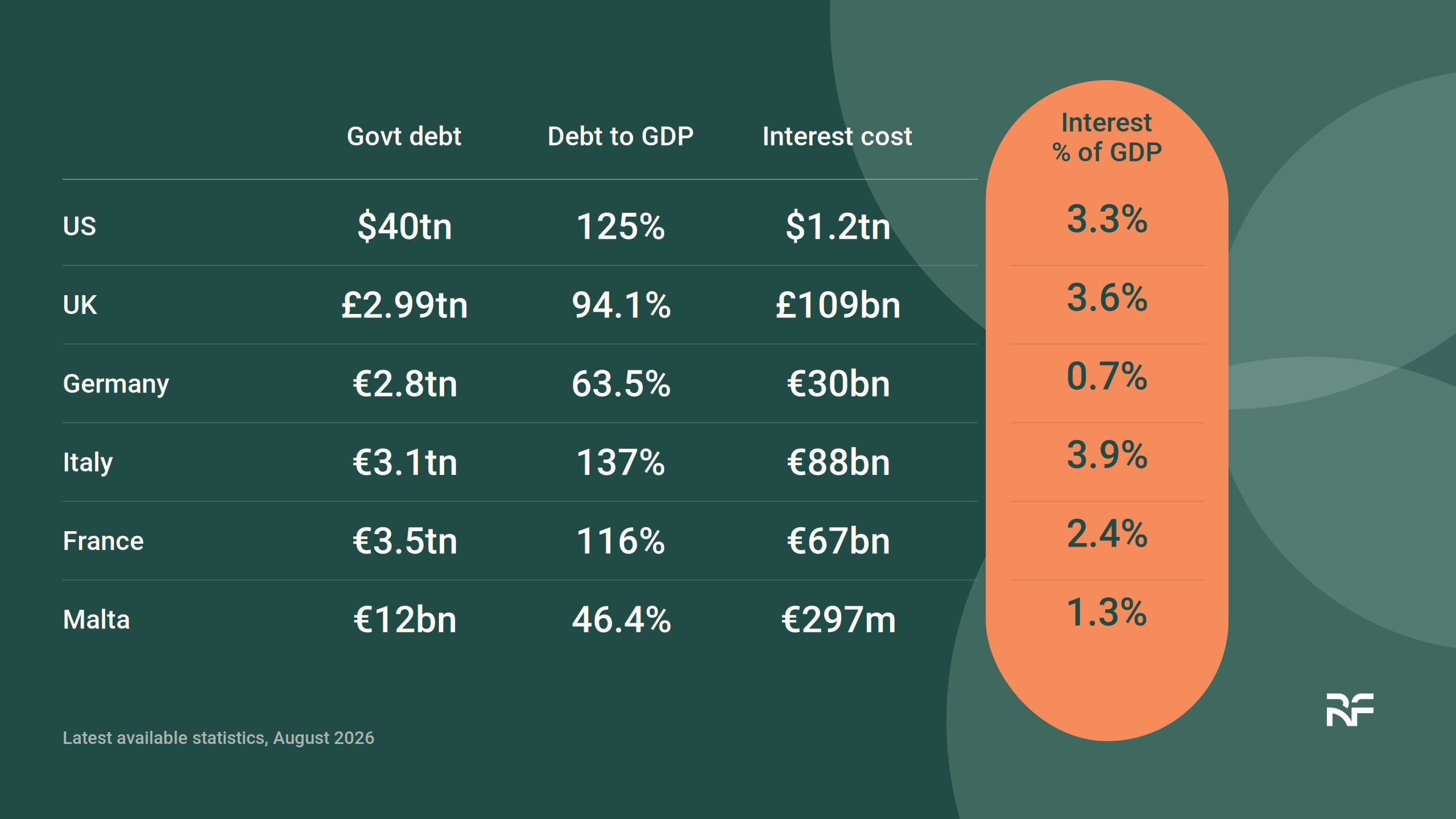
The growing debt levels of two countries in particular as they reached symbolic milestones were among the several important headlines across the international markets last week.
On Wednesday, the US Treasury confirmed that the gross federal debt had surpassed the USD40 trillion level for the first time while on Friday morning, the Office for National Statistics reported that the British public sector net debt stood at GBP2.985 trillion at the end of July, which is just short of the GBP3 trillion level.
The US and the UK are among two of the world’s most established sovereign borrowers and this data is important for those who regularly follow financial market developments, especially given the sharp rise in yields and the impact this has on the cost of servicing public debt. This news comes at a time when these same countries and others need to borrow record amounts to fund their budget deficits and to refinance their maturing bonds.
The sharp jump in US debt levels
The rapid pace of the rise in debt levels in the US is indeed noteworthy. The debt level effectively doubled in less than 10 years as it had reached just under USD20 trillion in January 2017.
The build-up has been even stronger in more recent months, adding approximately USD1 trillion every five months since the budget deficit is currently running at a level of 6% of gross domestic product (GDP).
Compared to the size of the economy, the US federal debt has surpassed 125% of GDP compared to circa 60% 20 years ago.
Observers across the financial markets are rightly focusing on the sharp rise in the cost of servicing the debt, which is currently at a level of almost USD1.3 trillion annually. Interest payments on government debt now surpass the cost of national defence and account for 20% of tax revenue. Interest costs are now equivalent to 3.3% of GDP, compared to under 2% of GDP in 2020, when the annual interest expense was USD345 billion. By November 2028, the cost of servicing public debt is expected to reach USD1.7 trillion per year, equivalent to almost USD5 billion per day.
The concerns across the bond market are reflected in the sharp rise in US Treasury yields, which make it even more costly to fund the growing debt levels. Last week, long-term US government borrowing costs rose to their highest levels since 2007. The yield on the 10-year US Treasury surpassed 4.7% and the 30-year yield reached 5.3% amid worries of an imminent escalation in the war with Iran and rising concerns over the deteriorating US fiscal position. The rise in yields effectively makes it more challenging to fund the budget deficit and also to refinance maturing debt.
Since the US government needs lower interest rates in view of the spiralling rise in the overall debt, last Wednesday the US Treasury Secretary Scott Bessent announced that the US Treasury would double its long-term debt purchases to at least USD4 billion to try to reduce yields. Although yields initially eased lower at this announcement, it proved to be short lived. Many economic commentators have rightly argued that this intervention only offers temporary benefits and does not address the major concerns surrounding the huge fiscal spending that pushed up borrowing costs.
The UK and Europe
The situation in the UK is very similar to that of the US. The UK’s public sector debt is now just below GBP3 trillion, equivalent to 94% of GDP, compared to 35% before the global financial crisis in 2008. Meanwhile, from the start of the pandemic just over six years ago, government debt has jumped by 64% as it had reached GBP1.8 trillion in early 2020.
Debt servicing costs have risen to more than GBP100 billion a year since 2022, which is currently equivalent to circa 3.6% of GDP and approximately 8% of all public spending, which is larger than the entire budget of the education department. According to the Office for Budget Responsibility, the interest on UK government debt will continue to exceed GBP100 billion annually until the early 2030s.
Last week, UK government bond yields also jumped to their highest level in nearly two decades, with the new issuance of 10-year gilts at a yield of 5.155%.
Across the eurozone, France has the highest debt level in absolute terms at €3.5 trillion, with a debt to GDP of 116% at the end of 2025. Debt servicing costs have also risen rapidly in recent years and are equivalent to circa 2.4% of GDP. The annual interest cost on public debt is the single largest item of the French state budget ahead of defence and education. Italy has the highest interest load at 3.9% of GDP. By contrast, the debt to GDP ratio of Germany is of 63.5% and debt servicing costs are currently below 1% of GDP.
How does Malta fare?
Against this backdrop, although Malta’s growing debt levels have also made headlines on several occasions across the local media, Malta’s position remains comforting when compared to various other countries, although the cost of servicing the public debt is now reaching high levels too in absolute terms.
According to the latest figures from the National Statistics Office, Malta’s total government debt amounted to just under €12 billion as at June 2026, which is less than 50% of GDP.
Interest payments on government debt grew to just under €300 million in 2025 and are projected to reach €384 million by 2028. Essentially, although these are large figures indeed and well above the amounts allocated to many important economic sectors, interest costs are only equivalent to circa 1.3% of GDP.
The NSO also measures the effective rate being paid on the government debt, which is still under 3%. The repricing impact from the historically low interest rates levels until 2022 will accelerate in the coming years as the amount of debt issued at the time of the pandemic in 2020 and 2021 at very low rates of interest will all be redeeming very soon. While this would be good for buyers of Malta Government Stocks, it would result in higher interest costs for the Malta Treasury.
Reaction across sovereign bond markets
Bond yields in the US, UK and Europe hit their highest levels in many years last week on concerns around the steep rise in government debt as well as the prolonged conflict in the Middle East, which should lead to higher levels of inflation for a longer period than expected. In fact, the central banks in the US, UK and Europe are all anticipated to raise interest rates at their next meetings in view of higher inflation expectations.
Many international commentators state that the current developments across the sovereign bond markets have become the main highlight, given the implications across all asset classes, especially since these are the most turbulent bond market conditions since 2022. At the time, the Federal Reserve and other central banks in the UK and Europe were raising interest rates at the fastest pace in 40 years as inflation proved to be far from “transitory”.
This article contains public information only and is published solely for informational purposes. It should not be construed as a solicitation or an offer to buy or sell any securities or related financial instruments. No representation or warranty, either expressed or implied, is provided in relation to the accuracy, completeness or reliability of the information contained herein, nor is it intended to be a complete statement or summary of the securities, markets or developments referred to in this article. Rizzo, Farrugia & Co. (Stockbrokers) Ltd (“Rizzo Farrugia”) is under no obligation to update or keep current the information contained herein. Since the buying and selling of securities by any person is dependent on that person’s financial situation and an assessment of the suitability and appropriateness of the proposed transaction, no person should act upon any recommendation in this article without first obtaining investment advice. Rizzo Farrugia, its directors, the author of this article, other employees or clients may have or have had interests in the securities referred to herein and may at any time make purchases and/or sales in them as principal or agent. Furthermore, Rizzo Farrugia may have or have had a relationship with or may provide or has provided other services of a corporate nature to companies herein mentioned. Stock markets are volatile and subject to fluctuations which cannot be reasonably foreseen. Past performance is not necessarily indicative of future results. Foreign currency rates of exchange may adversely affect the value, price or income of any security mentioned in this article. Neither Rizzo Farrugia, nor any of its directors or employees accepts any liability for any loss or damage arising out of the use of all or any part of this article. Additional information can be made available upon request from Rizzo, Farrugia & Co. (Stockbrokers) Ltd., Airways House, Fourth Floor, High Street, Sliema SLM 1551. Telephone: +356 2258 3000; Email: [email protected]; Website: www.rizzofarrugia.com © 2021 Rizzo, Farrugia & Co. (Stockbrokers) Ltd. All rights reserved. This article may not be reproduced or redistributed, in whole or in part, without the written permission of Rizzo Farrugia. Moreover, Rizzo Farrugia accepts no liability whatsoever for the actions of third parties in this respect.
This article was produced by Edward Rizzo, Director at Rizzo Farrugia, which is a company licensed to undertake investment services in Malta by the MFSA under the Investment Services Act, Cap. 370 of the Laws of Malta, and a member of the Malta Stock Exchange. The company’s registered address is at Airways House, Fourth Floor, High Street, Sliema SLM 1551, Malta.